Secrets of the Old Masters:
Imprimatura,Underpainting,Dead Colour Layer,Grissaille
 |
"The Torch Doth Not Burn Tonight" by Siriaus
|
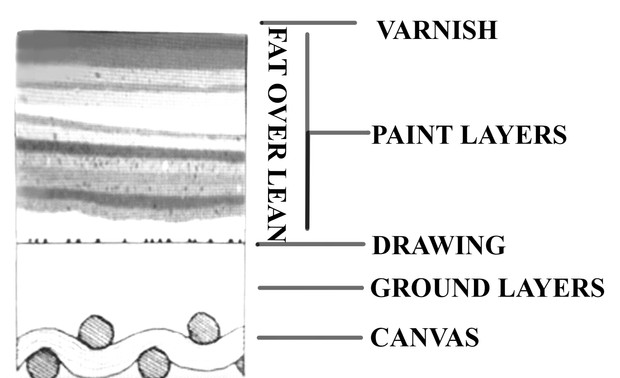
In the days of the Old Masters it was mandatory artists follow very strict and defined guidelines for the preparation of the painting process. For instance, the preparation of the "Dead Colour" layer for a full oil painting was utterly essential to the point that if this step was disregarded by the artist it would result in a penalty of a fine.
What was the "Dead Colour"Layer and why was it so important to the Old Masters?
First, I'll give a brief outline of the steps in order to approach this process successfully.The traditional oil painting method includes the following:
1. Preparation of the Support
The production of an oil painting starts with a sturdy support which could include: a stretched canvas (linen or cotton) or a board (wood panel). The support of the canvas is then sealed with glue (rabbit skin glue or Gamblin's Poly Vinyl Acetate "PVA" Size) and then a primer is layered on after. Or if a board is used as a surface instead of the canvas, adequate priming is only required in order to protect the surface (wood substrate) and form a barrier between the wood and oil paint.
2. Imprimatura
Although this step is optional, once the support is ready and the glue/size and priming have dried; a very thin layer of diluted oil paint (usually diluted with Turpentine or a healthier alternative such as: odorous"Turpenoid") is applied to cover the background of the canvas or board. This is called "Imprimatura" and it literally means in Italian the "first paint layer".It is so lightly applied that it becomes a transparent layer that allows the white background underneath to show through. It stains the white background with a low saturated earth tone colour (usually Raw Umber or Burnt Sienna) ;which takes away the brightness of the white background.
3. Transferring the Drawing
The drawing is then transferred unto the support and fixed with the brush and oil paint to establish the overall shapes of the composition.
4. Underpainting
The next layer is the "Under Painting" Layer. (Keep the "Fat over Lean" rule in mind as each subsequent layer is applied; there should be more oil added into the paint mixture of each progressive layer to comply to the "Fat over Lean" rule in oil painting).This step is essential as it provides a proper foundation of the scene/subject matter. The entire forms of the subject/scene should be added in this step to facilitate progressive steps in the painting process. This implies no detailing or decorating in this step rather focusing on the composition and values of the scene. The foundation of the piece should be the most important and once you've established a balanced scene and the composition is working;everything else will fall into place. In simpler terms, an Underpainting is a monochrome or a desaturated bare version of the final painting intended to initially fix the composition,give volume and substance to the forms and distribute darks and lights in order to create the effect of illumination.
This is a progress shot of the monochromatic Grisaille Underpainting that I have done to establish the values, shapes and forms in the composition.Watch this painting grow as I talk about the subsequent steps that follow in the next blog post I'm working on about glazing.
5. Dead Colour Layer
Once the Underpainting layer has dried the artist may decide to include a "Dead Colour Layer" in certain areas of the painting. The Dead Colour Layer was usually done in cold grey colours on top of the Underpainting and buried underneath the colourful Upper Layers. A Dead Colour Layer of grey on top of Umber produces a slightly purple toned Grisaille. Working in transparent warm colours of glazing on top of the Grisaille produces a very interesting effect of human skin. The surface of the skin is warm pinkish while the cold grey under-layers of "The Dead Colour Layer" are showing through creating an effect of realistic depth of the human skin (which is usually not one tone).
6. Colour Layer
Once the Dead Layer has dried the artist would lightly apply the flesh colours of skin on top of the "Dead Colour Layer" along with a multitude of colours for the rest of the scene.
7. Glazing
The artist may then apply layers of glazing for detailing and refinement.
8. Varnish
Once the painting has thoroughly dried,the varnish (protective coat) is usually layered on 6 months - 1 year after (the speed at which the painting dries depends on the thickness of the paint layers and the oil content in each layer) to seal the painting and protect it from the environment for the years to come.
These were the main steps of the traditional painting process that were executed by the Old Masters; a well structured process that was employed to produce exquisite fine art: true luxury.
As you may know oil paint takes time to completely dry and each layer should be thoroughly dry before applying another layer thus it takes time to create art in oil paint.The drying time of the paint depends on various factors such as:
-the chemical composition of the paint
-mediums
-volume/thickness of the layer
-the temperature of the surroundings of which you are painting in
-the ventilation of it's surroundings
When it comes to the underpainting layer, you must make sure that it is completely dry before proceeding and adding more layers on top of it. There are several methods you can employ to speed up the drying time and avoid damage to the upper paint layers.
1. Make sure you are using pigments that dry faster and bond together with oil.
Such paints like:
-Led White
-Natural and Burnt Ochre
-Red Mars
-Black Oxide of Iron
-Cobalt
-Berlin Azure
Paints that have slower drying times and form a soft film after drying are not suitable for the purpose of underpainting.
Such paints like:
-Titanium White
-Zinc White
-Lamp Black
-Krapplack
-Cadmium
-Ultramarine
2. In accordance with the main rule in oil painting "The Fat over Lean" rule; lower layers must contain less fat (oil) and be less elastic and more rigid than the upper layers. The layers in underpainting must contain the least amount of oil.
To conveniently reduce the oil content in the paint you can extract it by placing it on paper and allowing it to be absorbed by the paper. You can also add 1 part of Led White to 3 parts of the paint diluted with turpentine or Dammar varnish.This paint mixture makes the paint dry faster and allows the layer to become more rigid which is what is required for the lower layers (underpainting). Do not use oil mediums for the lower/underpainting layers unless you have you have enough time to wait for the initial layers to completely dry.
When the underpainting layer is dry it is a good idea to rub the surface with fine sandpaper to remove any excess film which may prevent proper bonding of the underpainting and the succeeding layers of paint. Many artists do a monochrome painting which is similar to Grisaille. The monochrome painting follows the same "Fat over Lean" rule. Technically, it could be done from light to shade by means of glazing (which are very thin transparent layers) or from dark to light using white paints. Brown Underpainting has often been used in oil painting right from the 15th to 17th centuries. Such an approach was widespread to the point that fine artists explored the possibility of painting on dark backgrounds.
Art Piece Name: "Christ and the Woman Taken in Adultery"
One example of an artist who was a Master at painting on dark brown backgrounds was Pieter Bruegel the Elder. He was skilled in combining such Underpaintings with intense transparent layers which he applied effortlessly. The application of painting in monochrome or one colour is a simple process because the fine artist isn't concerned with any other colours instead the artist is just focusing on the tonal values and balance of the elements in the composition. This actually speeds up the process of painting. This way the artist isn't bombarded with too many tasks such as: focusing on ensuring the colours are harmonious and securing the foundation/tonal values of composition.
UNDERPAINTING:
Working from Dark to Light
As I mentioned before some fine artists like to work on dark backgrounds and gradually build up the layers with lighter pigmented paint.Working from dark to light has many advantages, in fact many of the famous artworks were produced in this manner.
First the artist would cover the surface with a dark background (the Imprimatura is not required in this case). When the background is dry the artist would continue with lighter colours (usually Led White) that were applied very thinly and increasing in opacity and thickness with each progressive layer. They finished modelling the lightest areas of the scene with very opaque and impasto brush strokes which completely covered the background tone. Such an approach provided the infinite variety of transparent, semi-transparent and opaque gradations between light and shade.This allowed for the depiction of three-dimensional volumes of space and objects.
The method of painting on dark backgrounds was developed during the Baroque times; this style was used thereafter throughout Europe for over 300 years. Titian was a great master of applying this style of painting in his artwork. He would start off with a dark brown background (usually a dark brown red) then he would build up the layers by doing a Underpainting in white and finishing in opaque layers with full colour and colourful glazing.
Cupid with the Wheel of Fortune (ca. 1520) by Titian
Titian's Christ Flagellated (c.1560)
Christ and the Good Thief – by (Titian) Tiziano Vecellio (Titian), c. 1566
Paintings which are done on dark backgrounds might get darker with time; this happens because layers containing white paint turn out more transparent over a long period of time. This is the reason why so many old paintings appear so dark today. The method of painting on dark backgrounds (dark to light) is not a Baroque invention; it was used before the Renaissance times and even earlier in Medieval paintings. The method of painting from dark to light was used in the past and now is considered a Classical technique and some artists were using this approach even in the 19th century.
When the underpainting is done properly it facilitates the next steps of painting. Signs that indicate an artist has not used this method properly is when the underpainting is completely covered and altered with progressive layers of opaque paint. For a successful art piece, the underpainting is usually visible even once the artwork is completed.Colours were applied unto of the monochromatic underpainting only when they were dry. Basically, starting an art piece with the underpainting makes it much more easier for the artist. This allows the artist to only concentrate on the foundation of the artpiece without thinking about which colours to apply simultaneously. This process usually grants better results for artists that conceptualize their own scenes and visions. Underpainting is a very helpful Classical step in the method of painting; it exists in complete harmony with the overpainting and glazing.
GRISAILLE: Monochromatic Underpainting
From Leonardo Da Vinci,Rembrandt,Rubens to Titian; they all implemented the method of underpainting as a means of preparing the artwork's general structure.
Grisaille underpainting is just an underpainting done in monochromatic, greyish tones. The Grisaille layer can be done in one attempt or in several sessions. Fine artists must keep in mind that the grissaille layer is used with the intent to add colours on top. As the layers build up, the upper layers might have reduced bonding with the grisaille layer. The way an artist can resolve this and increase bonding is by rubbing the grisaille layer with fine sandpaper to smooth out the surface and then cover it with a retouch varnish. (Please note that any other type of varnish is not suitable for this type of application).
Because Grey Grisaille lacks colour many other artists choose to make their underpaintings in colour. Oil paints are mixed on the palette and tonal values are made deliberately lighter and less intense than the finished painting. During this step the artist is using a very limited range of colours. It is important to acknowledge the slight differences that exist between Grisaille painting and Grisaille underpainting.The purpose of a Grisaille underpainting is to act as an underlayer which will be painted on top of with colourful transparent layers of paint.While a Grisaille painting is a painting done only in monochromatic colours with no colours added on top. Grey Grisailles can be left alone as finished paintings. Sometimes artists would make paintings in Grey Grisailles because of it's efficiency,economical and aesthetic reasons. It's amazing how one can represent a three-dimensional reality with only a single hue.
It is unfortunate that the methods of the Old Masters are used less by modern artists due to the lack of education and patience. The method that is most employed by artists today is usually the quick Alla Prima(wet-on-wet) technique.It is hard to tell which of the underpainting methods is best; it depends on your creative tasks. One may be used for a maximum colourful effect another for an illusion of a three-dimensional space (Chiaroscuro).
If you found this post informative and helpful please subscribe to my Newsletter for more upcoming posts about painting techniques, art history,and anything art related.Thank you for visiting.