Showing posts with label light and shadow. Show all posts

Saturday, 11 June 2016

Why should art speak to us at an emotional level?

Why should art speak to us at an emotional level?

I have to admit finding inspiration can be difficult and tedious, ideas can come and go as they please- choosing which ones should stay is the tough part. Once you’ve FINALLY elected a theme, you should start setting about the process by using a plan which can be another daunting roller-coaster but well worth it. Nevertheless, your idea should explore what emotions you want your artwork to reveal. Great works of art captures physiology’s basic ideas, they speak to us at a deep, emotional level and great artists know that depicting feelings and mood is more important than precise representations of their subject.


Let’s use something as simple as a bouquet of flowers, bright and colourful flowers draw in a blissful emotion and at the other end of the spectrum. Dark and shady colours are intended to make the viewer feel dejected or angry.


Getting a thought provoking image can illustrate a good story line and these accounts of imagery then stimulate emotions. As an artist, if you can capture an emotion from the viewer then you’ve done your job. Here are some steps to help you translate your idea into a visual image- a tangible image.


First things first, get inspired! Many great artists go through a list of different motivations to get inspired-its valuable to expand your horizons by considering some of the ideas of other artists.

1.     Artists that create as part of a ritual, ceremony or cultural tradition have a specific purpose. This purpose has significance only within the art. 

Clay Matcha Bowl   An example is the Chanoyu or tea ceremony-a ritualized, secular practice in which tea is consumed. The tea is consumed in an intimate setting, allowing the participants to withdraw from the mundane world (tranquility and harmony is felt in this ceremony). Tea practitioners admire the qualities in the glaze, shape and texture of the tea cup and seek to consider if its worthy of artistic merit. These tea cups are created for the purpose of a Japanese cultural tradition.

Clay Matcha Bowl


An example is the Chanoyu or tea ceremony-a ritualized, secular practice in which tea is consumed. The tea is consumed in an intimate setting, allowing the participants to withdraw from the mundane world (tranquility and harmony is felt in this ceremony). Tea practitioners admire the qualities in the glaze, shape and texture of the tea cup and seek to consider if its worthy of artistic merit. These tea cups are created for the purpose of a Japanese cultural tradition.

2.     Artists that form a spiritual concept have the vision to express ‘creation’ which gives meaning to everything in life.

Hindu Temple Spires   Artworks that receive spiritual inspiration and guidance from a divine source convey spiritual messages to the uninitiated masses. Again the sense of peace and harmony are the focus of these pieces of art. A good example of this would be the temples in Hindu and Egyptian cultures, these works of art were carefully designed to symbolize mans path to enlightenment. The top tier or inner most sanctum of the temple represented the attainment of spiritual mastery. Initiates could spend many years meditating on the images to seek and learn the spiritual secrets they encoded.

Hindu Temple Spires

Artworks that receive spiritual inspiration and guidance from a divine source convey spiritual messages to the uninitiated masses. Again the sense of peace and harmony are the focus of these pieces of art. A good example of this would be the temples in Hindu and Egyptian cultures, these works of art were carefully designed to symbolize mans path to enlightenment. The top tier or inner most sanctum of the temple represented the attainment of spiritual mastery. Initiates could spend many years meditating on the images to seek and learn the spiritual secrets they encoded.

3. Many masterful artists felt it was important to record history and many of their paintings will depict a historical event.

Matirio di San Matteo by Carravagio   In the Renaissance era, oil paintings where the means of recording of visual data-telling the “truth” of what happened and what we need to know. Large and dramatic scenes were depicted presenting us with the reality of what occurred in the time of the event evoking intense and powerful emotions.

Matirio di San Matteo by Carravagio


In the Renaissance era, oil paintings where the means of recording visual data-telling the “truth” of what happened and what we need to know. Large and dramatic scenes were depicted presenting us with the reality of what occurred in the time of the event evoking intense and powerful emotions.


4.   Teaching using visual language is the motive of some artists, and probably the oldest purpose of art.
Sistine Chapel Stain Glass window   Images were used to teach and to help people remember religious concepts-for centuries the church was the primary patron of many artists. Viewers feel compelled to engage in the learning of the teachings making this kind of art influential in the behavior of others.

Sistine Chapel Stain Glass windo

Images were used to teach and to help people remember religious concepts-for centuries the church was the primary patron of many artists. Viewers feel compelled to engage in the learning of the teachings making this kind of art influential in the behavior of others.


5.   Reflecting on beauty is another way artists speak to their viewers.


Garden Path by Monet    People have broad notions of what is beautiful however there is a uniform opinion to what it is, generally speaking art that is pleasing to the senses will produce blissful emotions.

  Garden Path by Monet


People have broad notions of what is beautiful however there is a uniform opinion to what it is, generally speaking art that is pleasing to the senses will produce blissful emotions.


6.   Provoking others to see something in a new way is another motivation artists have for creating art.
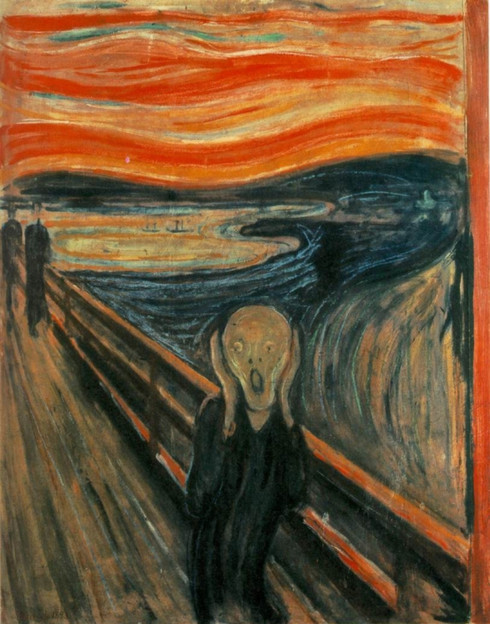

The Scream by Edward Munch. Simulating a reaction or emotion can sometimes force the viewer to see or think differently-having this impact is very powerful as it can propel strong emotions and on occasion's conflict.

The Scream by Edward Munch

Stimulating a reaction or emotion can sometimes force the viewer to see or think differently-having this impact is very powerful as it can propel strong emotions and on occasion’s conflict.


7.   As a narrative painter, I’m hugely influenced by the storytelling process- this would be another motive for artists to produce art.

As a narrative painter, I'm hugely influenced by the storytelling process- this would be another motive for artists to produce art.

Title:
"CALCULATED ORACLE: CAPRICORN"
by Siriaus

www.siriaus.comwww.siriaus.com


Art is a powerful means of storytelling with emotional roller coasters and those who have the ability to tell powerful stories and events in just one picture truly have a great gift.  In this painting I tried to capture a feeling of authority-a character that has absolute power over his subordinates. His godly figure and the deep colours tell us he is someone of supremacy and we should be reluctant to do something for fear of the consequences.
Title:
"EPICUREAN HEDONIST" (Taurus) :Project Member #4
by Siriaus


 "Nothing is enough for the man to whom enough is too little" -Epicureus
Art is a powerful means of storytelling with emotional roller coasters and those who have the ability to tell powerful stories and events in just one picture truly have a great gift.  In this painting I tried to capture a feeling of authority-a character that has absolute power over his subordinates. His godly figure and the deep colours tell us he is someone of supremacy and we should be reluctant to do something for fear of the consequences.
 Title:
"EPICUREAN HEDONIST" (Taurus) :Project Member #4
by Siriaus


 "Nothing is enough for the man to whom enough is too little" -Epicureus

Art is a powerful means of storytelling with emotional roller coasters and those who have the ability to tell powerful stories and events in just one picture truly have a great gift.  In this painting, "The Calculated Oracle", I tried to capture a feeling of authority-a character that has absolute power over his subordinates. His godly figure and the deep colours tell us he is someone of supremacy and we should be reluctant to do something for fear of the consequences.
What emotions do you have when looking at this image?

Obviously, there are many more sources of inspiration for artists-I’ve listed a few but it's up to you to use your imagination and come up with a piece of work that you’re proud of.

As always, I’m interested in seeing your feedback/thoughts, which you can add to the comments area below. If this was a helpful read-do sign up to the newsletter for more related info and share this post via social media. I will be very grateful!

Saturday, 4 June 2016

Physics/Science of Light (PART 2)

(How you could implement it + create dramatic compelling art scenes)


Understanding how to create compelling art scenes with different lighting schemes and dramatic shadows is critical to a proficient artist. We should try to understand the physical interactions light has with various surfaces and textures and how our eyes and brains react in order to interpret information. Also how we can make scenes visually appealing.


Types of Lighting Schemes: 


Key Light: The key light, generally speaking, is the strongest light source, it is the one that defines the emotional impact of your scene. It is the dominant light source in the scene that affects the form of the object.

Key Light: 
The key light, generally speaking, is the strongest light source, it is the one that defines the emotional impact of your scene. It is the dominant light source in the scene that affects the form of the object.


Fill Light: The fill light, generally speaking, is usually a softer light that isn't as bright as the key light. It's role is to fill in the shadows so that they aren't as dramatic and dark. Fill lights can sometimes be used to add more excitement to the scene, such as shining a red light on a specific portion of the object; which can take on the role of a fill light

Fill Light: 
The fill light, generally speaking, is usually a softer light that isn't as bright as the key light. It's role is to fill in the shadows so that they aren't as dramatic and dark. Fill lights can sometimes be used to add more excitement to the scene, such as shining a red light on a specific portion of the object; which can take on the role of a fill light.


Rim Light:  The rim light is when light is being directed from behind the object, catches on, and wraps around the outer edges of the object. It is often used to help define and outline shapes in a scene that would otherwise be lost in darkness. It helps add dramatic appeal, but it has little affect in describing the form of the object. It's dominant purpose is to add emotional and compositional impact. Any lighting scheme will be a combination of these 3 lights I have just mentioned.
Rim Light: 
The rim light is when light is being directed from behind the object, catches on, and wraps around the outer edges of the object.
It is often used to help define and outline shapes in a scene that would otherwise be lost in darkness. It helps add dramatic appeal, but it has little affect in describing the form of the object. It's dominant purpose is to add emotional and compositional impact. Any lighting scheme will be a combination of these 3 lights I have just mentioned.


This is the 3 point lighting scheme and it is often used in photography.    Although, I don't think it's necessary to use all 3 of them,the most important point to remember is that one light must always be the most dominant so that the viewer knows where to look in the scene. There are a lot of permutations that you can explore with in terms of lighting, so experimenting is effective when used in conjunction with the basics.  There are probably certain schools of thought that abide by dogmatic rules in terms of lighting schemes but experimentation breeds innovative and imaginative art.
This is the 3 point lighting scheme and it is often used in photography.

 Although, I don't think it's necessary to use all 3 of them,the most important point to remember is that one light must always be the most dominant so that the viewer knows where to look in the scene. There are a lot of permutations that you can explore with in terms of lighting, so experimenting is effective when used in conjunction with the basics.  There are probably certain schools of thought that abide by dogmatic rules in terms of lighting schemes but experimentation breeds innovative and imaginative art.


Sunlight, spotlight or distant light sources tend to be fairly neutral lights.

Sunlight, spotlight or distant light sources tend to be fairly neutral lights.


On the other hand, when you have nearby sources or a focused point light source with multiple objects in a scene the nearby light sources tend to be more active; adding tension to the scene.They can be harder to paint because the light is changing at every angle, but the scene can look much more interesting due to this very reason. In contrast, if you're not careful or use this lighting scheme inappropriately than it can come off as a distraction.


On the other hand, when you have nearby sources or a focused point light source with multiple objects in a scene the nearby light sources tend to be more active; adding tension to the scene.They can be harder to paint because the light is changing at every angle, but the scene can look much more interesting due to this very reason. In contrast, if you're not careful or use this lighting scheme inappropriately than it can come off as a distraction.


On the other hand, when you have nearby sources or a focused point light source with multiple objects in a scene the nearby light sources tend to be more active; adding tension to the scene.They can be harder to paint because the light is changing at every angle, but the scene can look much more interesting due to this very reason. In contrast, if you're not careful or use this lighting scheme inappropriately than it can come off as a distraction.


Oversized or Diffuse Light Sources: 


With oversized or diffuse light sources, you can achieve a very soft and friendly appearance for your scene.These type of light sources are often used to make fashion models look attractive in magazines. When used in movies, they would use double the fill lights as oversized sources to cause the audience to feel more engaged with the character(s). By allowing certain areas of an object to reside in shadows or having another object placed intentionally near or above the object partially casting shadows this will evoke a mysterious tone to the scene. For example, imagine you set up a scene with a guy standing inside a room peering out the window and you place a soft diffused light on him, well this will tend to make him look more friendly and approachable. Whereas if you have bands of light coming in through the window blinds in a scene it will start to feel more mysterious or eerie.
 
With oversized or diffuse light sources, you can achieve a very soft and friendly appearance for your scene.These type of light sources are often used to make fashion models look attractive in magazines. When used in movies, they would use double the fill lights as oversized sources to cause the audience to feel more engaged with the character(s). By allowing certain areas of an object to reside in shadows or having another object placed intentionally near or above the object partially casting shadows this will evoke a mysterious tone to the scene.
For example, imagine you set up a scene with a guy standing inside a room peering out the window and you place a soft diffused light on him, well this will tend to make him look more friendly and approachable. Whereas if you have the man standing in a dark room and bands of light are coming in through the window blinds it will start to feel more mysterious or eerie.


The information presented here is only the basics of light's physics (part 2) ,stay tuned for part 3 of "Physics/Science of Light" by subscribing to my newsletter for more related updates.
Please share if this blog post was helpful to you in any way it would mean a lot to me.

Thanks for the visit, cheers:)